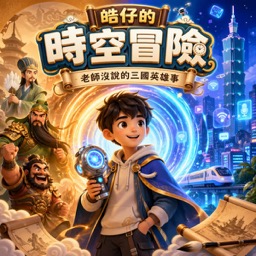
THREE KINGDOMS · HISTORY VS. NOVEL
Records of the Three Kingdoms vs. the novel: teaching kids that a story isn’t always the truth
Lots of kids have heard the story of borrowing arrows with straw boats and believe it was Zhuge Liang’s idea. Tell them that historically, the person this actually happened to was Sun Quan, and they usually freeze for a second, then won’t stop asking questions. Adding one question when you tell Three Kingdoms stories, “Is this true, or a story?”, is great practice in thinking.
One is history, the other is a novel
Records of the Three Kingdoms (Sanguozhi) is a history book written by Chen Shou in the Western Jin dynasty. Later, Pei Songzhi of the Southern Dynasties added extensive commentary to it, bringing in accounts from many other books. Romance of the Three Kingdoms is a novel from the Ming dynasty, more than a thousand years later, generally attributed to Luo Guanzhong. He reworked the histories, folk legends and stage plays into gripping stories.
You can put it to kids like this: one is a “record,” the other is an “adaptation.” Adaptations are great to read, but they aren’t necessarily true.
Example 1: The Oath of the Peach Garden
In the novel, Liu Bei, Guan Yu and Zhang Fei swear brotherhood in a peach garden. The official history has no record of an oath. It only says that Liu Bei, Guan Yu and Zhang Fei slept in the same bed and were as close as brothers. The friendship was real; the oath ceremony was added by the novel.
Example 2: Borrowing arrows with straw boats
The novel has Zhuge Liang using straw boats to borrow arrows from Cao Cao’s army before the Battle of Red Cliffs. But an account from the Weilüe, quoted in Pei Songzhi’s commentary, says this: years later, at the Battle of Ruxu, Sun Quan sailed out on a large boat to look at Cao Cao’s army. One side of the boat was so full of arrows that it was about to tip over, so he turned the boat around to let the other side take arrows too, and headed back once the boat was level. The main character is different, and so are the time and place.
Example 3: Slaying Hua Xiong before the wine went cold
In the novel, Guan Yu goes out to fight, and the wine Cao Cao poured for him is still warm when he returns, having already killed Hua Xiong. The official history records that Hua Xiong was killed when Sun Jian defeated Dong Zhuo’s army. Guan Yu had nothing to do with it.
Example 4: The Empty Fort Strategy
Zhuge Liang opening the city gates and playing the zither to scare off Sima Yi is the novel’s most famous scene. Pei Songzhi’s commentary quotes a similar account, but Pei Songzhi himself doubted it: Sima Yi wasn’t even on that battlefield at the time. Most historians think it never happened.
Example 5: Seven captures of Meng Huo
This example works the other way around. Chen Shou’s Records of the Three Kingdoms only briefly mentions Zhuge Liang’s southern campaign. The “seven captures and seven releases” survive because Pei Songzhi’s commentary quotes them from the Han-Jin Chunqiu. The novel didn’t make it up, but it isn’t in the main text of the official history either. It’s “what another book says.”
Three questions to practice with your child
- Who wrote this? When was it written?
- Do any other books or sources say the same thing?
- Why did the author write it this way? To keep a record, or to make the story better?
These three questions aren’t just for the Three Kingdoms. When kids are older and watching the news or videos online, they can think things through the same way. To me, that’s the most valuable part of telling Three Kingdoms stories: the stories are great, and we can still tell which parts are fact and which are just what someone said.
FAQ
Will telling kids the novel isn’t true spoil the fun?
Usually not. Kids often get more interested once they find out what really happened. You can stress that the novel is a carefully crafted adaptation and a great work; it’s just different from history.
What is Pei Songzhi’s commentary?
Chen Shou’s Records of the Three Kingdoms is fairly concise. Pei Songzhi of the Southern Dynasties wrote a commentary on it, quoting from over a hundred other books to fill in the details. Some of these accounts contradict each other, and Pei Songzhi also wrote down his own judgments. Many of the Three Kingdoms stories we know so well actually come from his commentary.
Do kids need to read the original texts?
No. Hearing the stories and talking about the differences is enough. When your child is older and interested, you can read a modern translation or a children’s version of the history together.
This article is general parenting information and is not a substitute for medical or professional advice. If you have concerns about your child's development or health, talk to your pediatrician or another qualified professional.
Hear the history and the novel side by side
Every episode of Hao’s Time Adventures (in Mandarin Chinese) puts the official history and the novel next to each other, so kids can judge for themselves.